

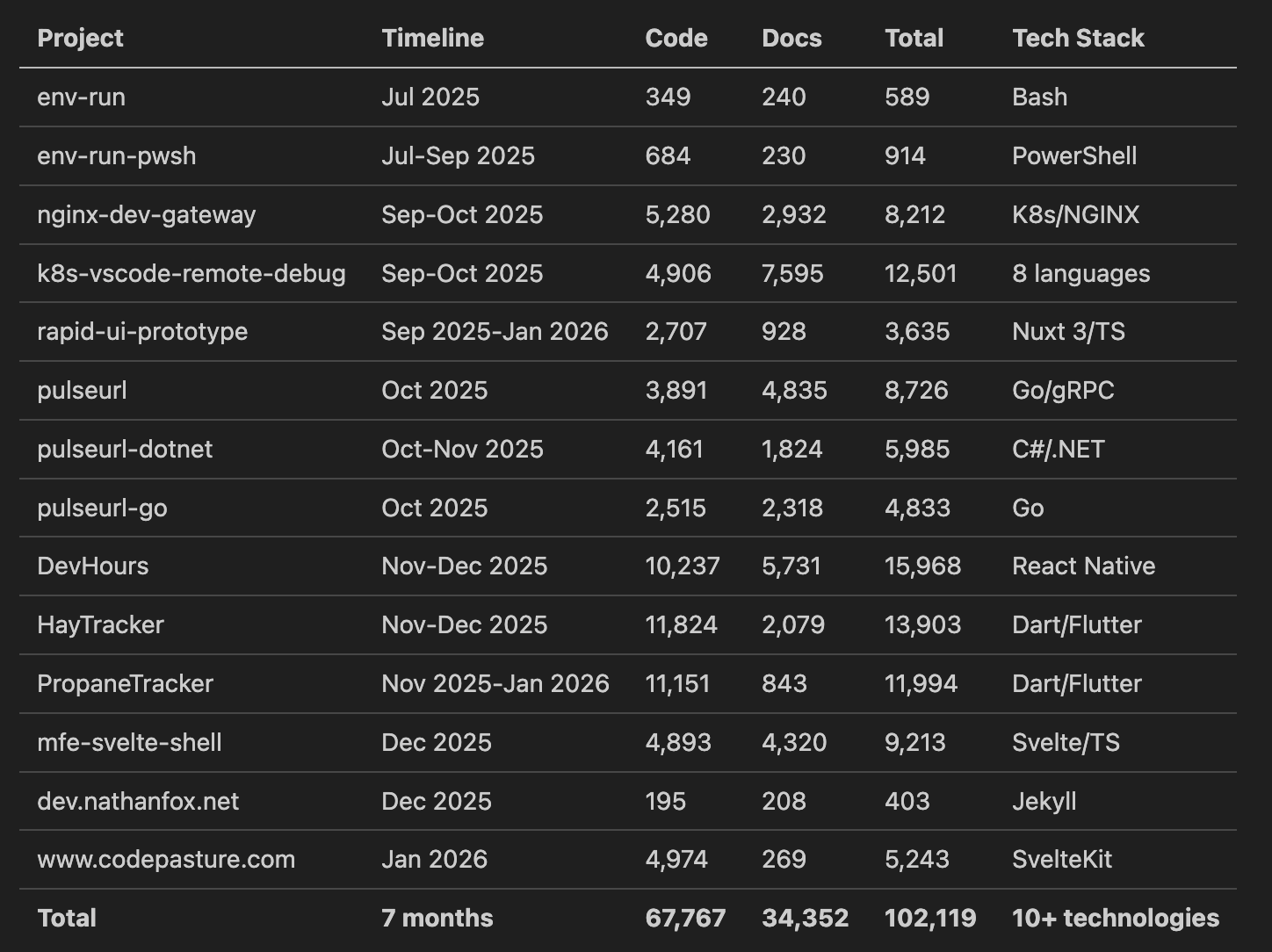
In the past seven months, I’ve written over 67,000 lines of code and 34,000 lines of documentation across 14 different projects spanning 10+ technology stacks. I’ve shipped three mobile apps to the iOS App Store. I’ve built developer tools, traffic monitoring services, micro-frontend reference implementations, and business websites. I’ve formed a company, Code Pasture LLC, to house some of these products and services.
This would not have happened without Claude Code.
I don’t mean it would have taken longer. I mean it would not have happened at all. The time investment would have been prohibitive. The mental calculus that every developer knows—”is this project worth the weeks of evenings it will take?”—would have killed all of these ideas before they started.
But something fundamental has changed. With Claude Code, days of work now take hours. Even a single spare hour can be genuinely productive, not just “getting back into flow” time. The barrier to starting has dropped so dramatically that projects I would have dismissed as impractical are now not only possible but shipped and running in production.
The Before and After Reality
Every developer has a graveyard of unbuilt projects. Ideas that seemed great until you calculated the real cost: weeks of evenings after work, weekends sacrificed, the slow grind of building everything from scratch. Most projects die in that calculation phase. The ones that survive often stall halfway through when life gets in the way and you lose momentum.
I’ve been a professional developer for over three decades. I have a good sense of how long things take. A mobile app with proper architecture, database layer, state management, and polished UI? That’s months of focused work. A multi-language reference implementation for Kubernetes debugging? That’s a substantial project requiring expertise in each language ecosystem. A traffic monitoring service with client libraries for multiple platforms? That’s an entire product.
Before Claude Code, I couldn’t realistically tackle even one side project per year. The economics simply didn’t work.
Now? The math is completely different. What used to take days takes hours. What used to take weeks takes days. And critically, I can make meaningful progress in sessions as short as an hour. That changes everything about what’s possible in spare time.
Seven Months of Building: The Projects
Here’s what I built from July 2025 through January 2026:
Developer Tools
env-run and env-run-pwsh solve the problem of managing multiple environment configurations (dev, uat, prod) with layered configuration and secure secret management. The Bash version came first, then I ported it to PowerShell for cross-platform support. These are small but genuinely useful tools that I use daily.
nginx-dev-gateway is a namespace-aware NGINX-based API gateway for Kubernetes that lets developers access multiple microservices through a single kubectl port-forward command. It supports path-based routing, WebSocket connections, and hot-reload configuration. I use this every day at my job—it has transformed my development workflow.
k8s-vscode-remote-debug is a comprehensive reference repository providing production-ready examples for remote debugging applications in Kubernetes from local VS Code. It supports eight languages: C#, F#, Node.js, Python, Go, Java, Rust, and Elixir. Each implementation includes Dockerfiles, Kubernetes manifests, VS Code launch configurations, and management scripts.
Traffic Monitoring (PulseURL Ecosystem)
PulseURL is a high-performance traffic monitoring service I built in Go with gRPC. It collects and aggregates HTTP request metrics with Redis for time-series storage.
pulseurl-dotnet provides a production-ready .NET client library and ASP.NET Core middleware with async buffering, exponential backoff retry logic, circuit breaker patterns, and batch streaming for 10x+ throughput improvement.
pulseurl-go is the Go client with Gin middleware, offering the same fire-and-forget design pattern with automatic retries and sampling support.
Building a complete observability product with clients for multiple platforms would traditionally be a significant undertaking. With Claude Code, I had the entire ecosystem working in under a month.
Mobile Apps
The mobile apps were the most satisfying to ship because they’re real products that real people use.
DevHours is a timer-based time tracking app for developers. It tracks time against projects and work items, categorizes by task type, generates reports, and exports to CSV. It was my first mobile app, built with React Native and Expo, following strict TDD practices with 148 tests.
HayTracker is a Flutter app for tracking hay and straw bale inventory, designed for farmers and livestock managers to monitor feed and bedding supplies. It features SQLite storage, CSV export, and Material Design 3 UI.
PropaneTracker is a Flutter app for tracking propane tank usage, deliveries, and consumption. Like HayTracker, it’s built on SQLite with comprehensive data management features.
All three apps are available on the iOS App Store. PropaneTracker and HayTracker are also live on Google Play, with DevHours Android coming in 2026.
Web and MFE Projects
rapid-ui-prototype demonstrates a GenAI-powered rapid prototyping system with side-by-side prototype/production architecture. It includes eight pre-configured scenarios (Normal, Empty, Large Dataset, Error States, etc.) and seamless migration paths from prototype to production code.
mfe-svelte-shell is a reference implementation of micro-frontend architecture with a lightweight Svelte 5 shell orchestrating MFEs built in React, Vue, SolidJS, and Angular. It demonstrates static manifest registration, cross-MFE communication, and mock authentication patterns. I used this as the blueprint for building a production MFE system at my job, as described in From MFE Blueprint to Development Platform.
dev.nathanfox.net serves as a central hub for documentation, legal pages, and scripts.
www.codepasture.com is the marketing website for my new company, built with SvelteKit.
The Numbers: What Would This Have Taken?
How long does it take to write production code? Industry benchmarks vary, but studies consistently show experienced developers produce 50-80 lines of tested, production-ready code per day on average. The classic “Mythical Man-Month” cites even lower figures for large projects. Solo developers with no meetings or bureaucracy trend toward the higher end. Here’s how long each project would take using both benchmarks:
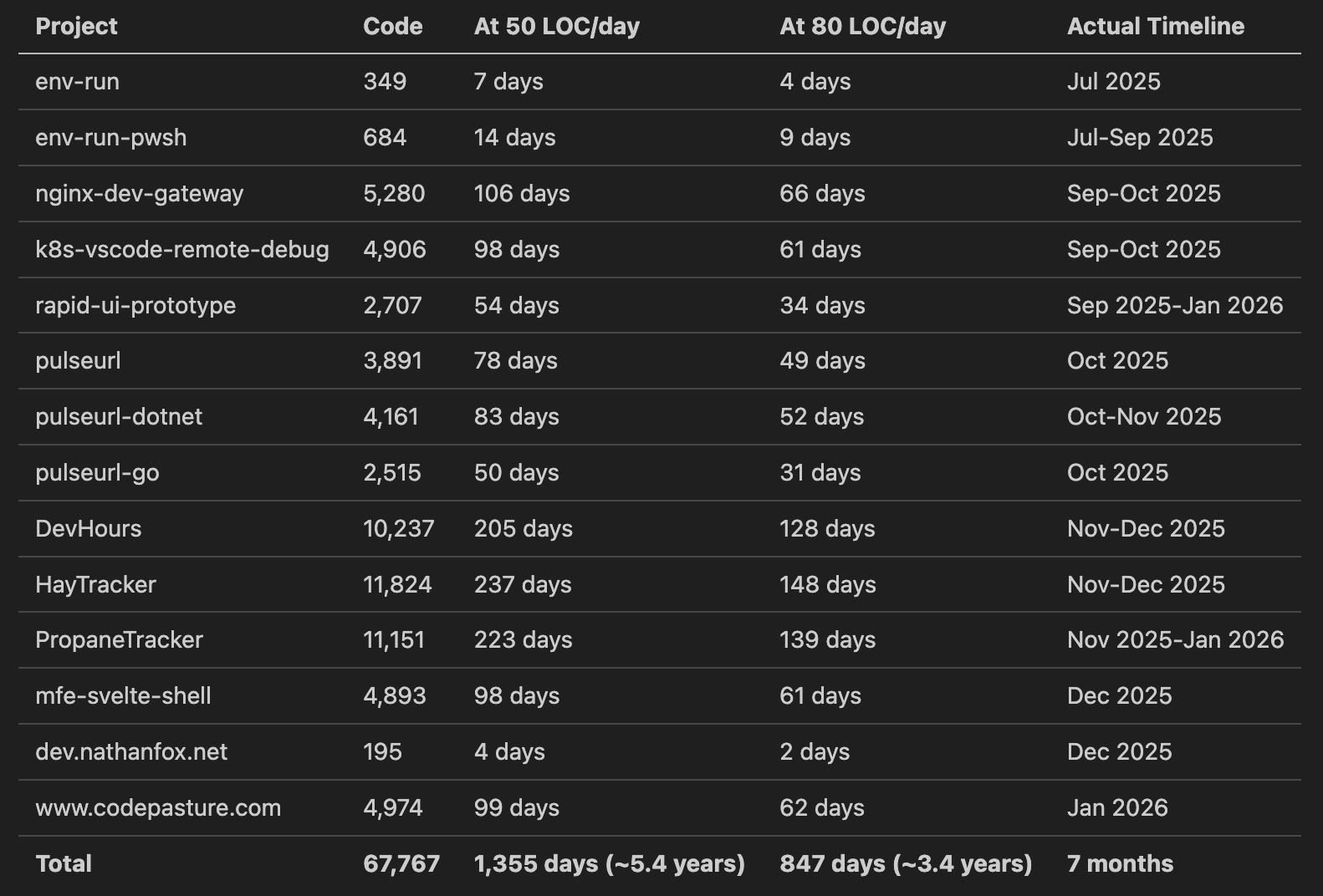
The “Actual Timeline” column shows when each project was built—the calendar span from first commit to completion. But how many hours did I actually invest?
Working 10-15 hours per week over 7 months:
7 months × 4.3 weeks × ~12.5 hours/week = ~375 hours
67,767 lines ÷ 375 hours = ~180 lines per hour
That’s roughly 1,440 lines per 8-hour equivalent day—18-29x the traditional benchmarks. The numbers sound implausible until you try it yourself. But the git commits are there, the apps are in the app stores, the projects are real and working.
The documentation column is worth noting: 34,000 lines of markdown documentation that also wouldn’t exist without Claude Code. This includes comprehensive READMEs, API documentation, setup guides, and architecture explanations. In traditional development, documentation is often the first thing cut when time gets tight.
But here’s the key insight that the numbers don’t capture: without the productivity multiplier, I wouldn’t have attempted any of these projects at all. The multiplier isn’t just about doing things faster—it’s about crossing the threshold where projects become worth starting. When you can make real progress in a single evening, the calculus changes completely.
The Technology Diversity
One of the most striking aspects of this period is the breadth of technologies I worked with productively:
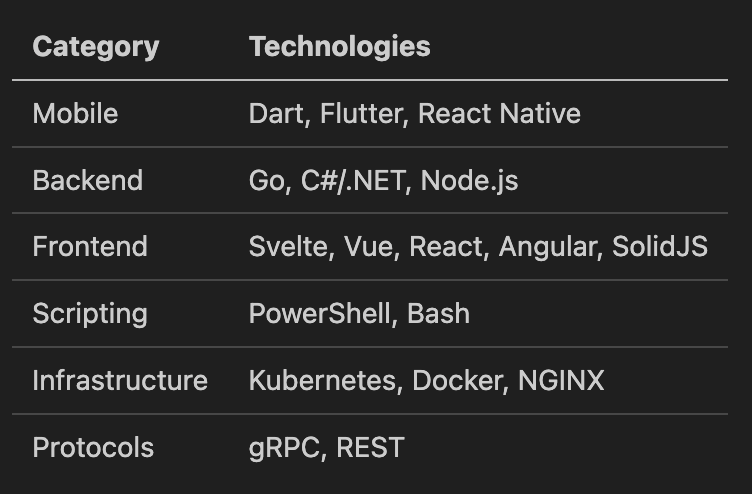
In traditional development, switching between technology stacks carries significant context-switching costs. Each ecosystem has its idioms, best practices, tooling, and gotchas. Learning them all at a professional level would take years.
With Claude Code, I can work effectively in technologies I don’t use daily. The agent knows the idioms. It knows the gotchas. It generates code that follows best practices for each ecosystem. I still need to understand what’s being generated and make architectural decisions, but the implementation friction is dramatically reduced.
This has profound implications for what individual developers can accomplish. You’re no longer limited to your primary tech stack.
The Business That Resulted: Code Pasture LLC
The volume and quality of output reached a point where forming a business made sense. In late 2025, I founded Code Pasture LLC.
The company has three mobile apps shipped to the iOS App Store, with HayTracker and PropaneTracker also on Google Play:
DevHours: Time tracking for developers
HayTracker: Inventory management for farmers
PropaneTracker: Propane tank monitoring
Two more mobile apps are in active development and planned for release in 2026.
Beyond products, Code Pasture offers services for companies looking to adopt modern architectures:
Mobile app development (Flutter/React Native)
Micro-frontend shell development
MFE development across frameworks
Microservices architecture and implementation
None of this would exist if building software still took as long as it used to. I wouldn’t have had enough shipped products to justify a company. I wouldn’t have had the breadth of expertise across technologies to offer meaningful services. The business itself is a direct consequence of GenAI-enabled productivity.
Professional Impact: Beyond Side Projects
The benefits extend beyond personal projects. In my day job over the past four months, I’ve accomplished work that would have taken over a year using traditional development approaches.
There’s a compound effect at play: the skills I developed building personal projects—particularly around effective prompting, planning-driven development, and example-driven development—transferred directly to professional work. Each project made me better at working with GenAI agents, which made the next project faster, which built more skills.
This isn’t just about me. Teams that master these tools now will have a significant advantage over those that don’t. The gap between developers who leverage GenAI effectively and those who don’t is already substantial and growing.
What Made This Possible
Raw productivity gains aren’t automatic. Several practices made the difference:
Planning-Driven Development
I don’t start coding immediately. I start with a structured planning document that Claude Code helps create and then uses as context during implementation. This approach is detailed in Planning-Driven Development with GenAI Agents.
Planning first eliminates the “build it wrong then fix it” cycle that wastes so much time in traditional development. The agent understands the goals, constraints, and architecture before writing any code.
Example-Driven Development
Once you’ve figured out a working pattern—whether it’s Kubernetes debugging configuration, a micro-frontend shell setup, or a specific testing approach—capture it in a reference repository. Then point Claude Code at that example when implementing similar patterns in new projects.
This approach, detailed in Example-Driven Development: Using Working Code Examples to Guide AI Agents, has been transformative. Instead of rediscovering solutions through trial and error, I can say “follow the pattern in this repo” and get consistent, working implementations. The k8s-vscode-remote-debug and mfe-svelte-shell projects both started as examples that I’ve reused across multiple projects.
CLAUDE.md Configuration
Each project has a CLAUDE.md file that configures Claude Code with project-specific context, coding standards, and common gotchas. This eliminates the need to repeatedly explain the same things and ensures consistency across sessions.
Tool Stack
I use Claude Code as the primary coding agent, with GitHub Copilot for inline completions. The combination provides both autonomous implementation capability and seamless in-editor assistance.
Conclusion
Let me return to the thesis: these projects would not exist without GenAI agents.
Not “would have taken longer.” Would not exist.
I’ve been coding for over thirty years. I know what I could accomplish in spare time before this technology existed. The three mobile apps, the traffic monitoring ecosystem, the multi-language Kubernetes debugging reference, the MFE shell—none of these would have made it past the idea stage. The time investment would have been too high, the opportunity cost too great.
What we’re witnessing is a democratization of software development capability. Individual developers can now accomplish what previously required teams. Side projects can become real products. Ideas can become businesses.
The compound effect is just beginning. As I get better at working with these tools, as the tools themselves improve, as inference speeds increase—the multiplier will only grow.
I have two more mobile apps in development. More tools. More services to offer through Code Pasture. The project graveyard of unbuilt ideas is emptying out.
What projects have you been putting off because the time investment seemed too high? The math may have changed more than you realize.
Download the Apps
DevHours - Time tracking for developers
Android coming Q1 2026

HayTracker - Inventory management for farmers

PropaneTracker - Propane tank monitoring
Related posts: